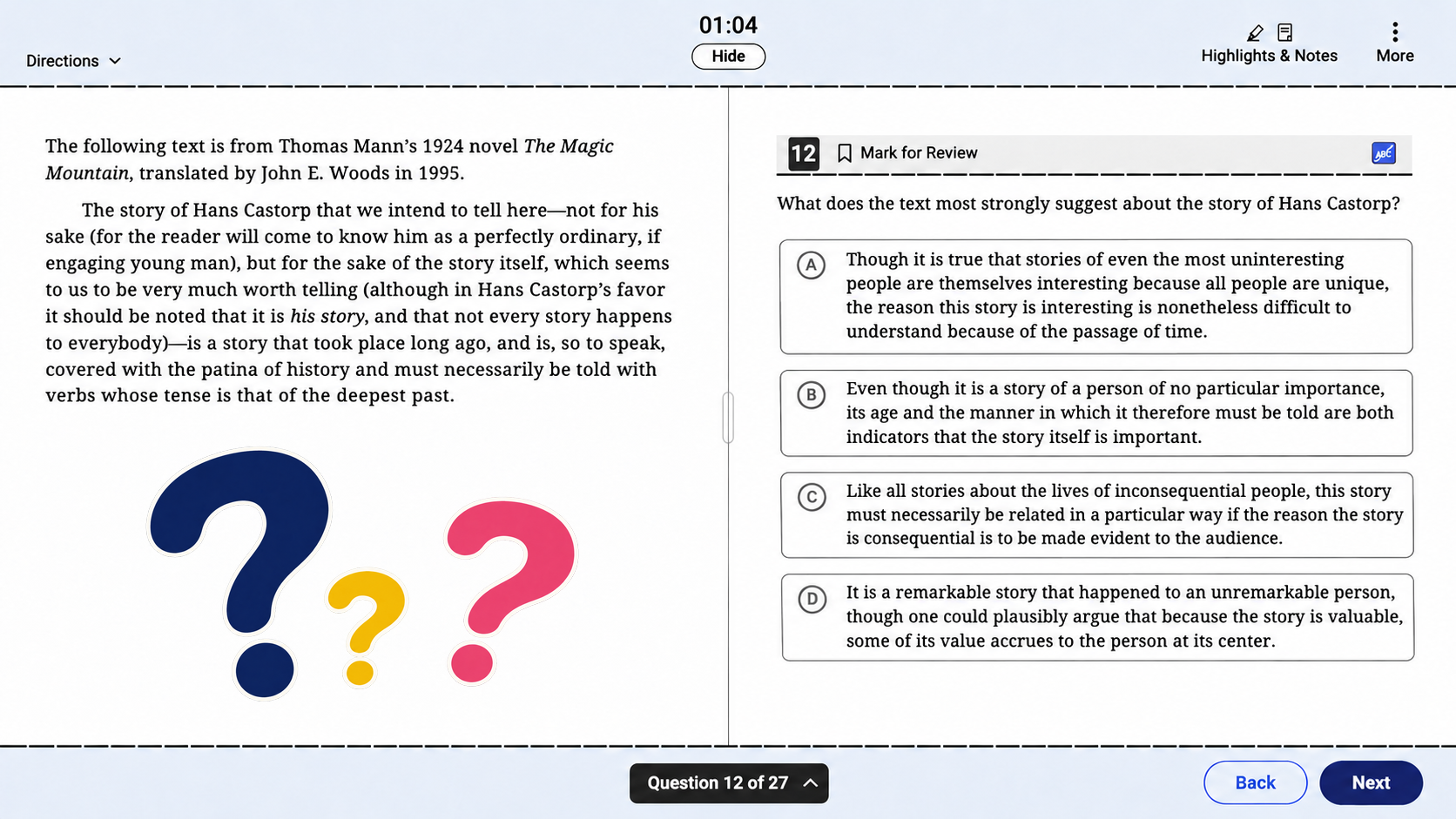
You read the passage. You read it again. Then you get to the answer choices, and somehow two of them seem right, two of them seem like they’re talking about a completely different piece of text, and none of them says what you expected.
Welcome to the SAT’s hardest reading questions.
I don’t have a magic wand strategy to make these questions easy. I don’t think one exists. If you have one, please let me know; I would absolutely love to hear it.
But there are ways to make them more manageable: how you budget your time, how you break down the passage, and what you do when the answers aren’t cooperating. In this post, we’ll explore some of the best ways to make these problems feel more approachable.
What makes these problems so special?
The hardest reading questions require a significant time investment in multiple stages of the problem-solving process. You first have to invest a bunch of time and mental energy into reading and processing the passage; then, you’ll also be required to put substantial effort into reading, analyzing, and applying the answer choices to that passage.
Most other question types are slanted toward one or the other. For instance, on vocabulary-in-context questions, you spend time analyzing the paragraph to figure out what idea is missing; if you know the vocab words in the answer choices, though, there’s usually very little analysis required to pick the best answer.
The hardest reading questions, however, hit you with both.
Before we get into strategy, an important note: you don’t need to get these questions right to get a good score on the section. Given the challenge and the amount of time and energy required, I make these a priority mainly for students aiming for an extremely high Reading and Writing score. This is not something for everybody.
Flight, then fight
I describe my general approach as not ‘fight or flight’, but ‘flight, then fight’.
Because of the time and energy required to answer these questions, my default advice is to save them for last. Do the vocabulary questions at the beginning; skip over the passage questions; work through grammar, transition words, and bullet points; and then come back to the text and graph questions.
Note that this isn’t a hard-and-fast rule; the best way for you to approach the module may depend on your preferences and strengths. If you discover that you do better tackling everything in order, that’s fine. This is simply a starting point.
The reason for this sequencing of the module is twofold. First, a smaller number of questions and a smaller amount of time to distribute among them is easier to get your arms around than one big blob of 27 questions in 32 minutes.
Second, it gives you a bit of a psychological safety net. Sitting there confronted with an incredibly difficult passage, knowing you still have two-thirds of the module left, adds pressure that is detrimental to your ability to read and comprehend.
Even when you come back to the passage questions, save the densest ones for the end. The length of the answer choices can be a pretty good way to diagnose density quickly. A four- or five-sentence passage followed by choices that are all three or four lines long? That’s a recipe for a time sink.
Just make sure you return to any unanswered questions before the module ends. You can’t go back once you’ve moved on to the next module.
Chew your food as you go
I’m a big advocate of breaking the text into small pieces and ‘chewing your food’ as you go.
For most students, the instinct is to start at the beginning, read the whole passage, and go straight to the answer choices. Sometimes that works great. On harder passages, though, you’ll often get to the end and think, “What did I just read?” You’re then forced to go back to the beginning and read the whole thing again, which absolutely tanks your pacing.
Instead of falling into this trap, stop at the end of each sentence—you can break the text up into even smaller pieces if the passage is really dense—and ask:
How do I paraphrase what I just read? Use your own words as much as possible. If you’re just reading the sentence back to yourself almost word for word, there’s no guarantee you’ve actually gotten anything out of it.
How does this relate to what came before it? As you get later in the passage, don’t just ask what the sentence gave you—ask how it changed your understanding of what you’ve read as a whole. Transition words are a big help with that: words like ‘however’ and ‘therefore’ give you a sense of how the ideas in the passage are related to each other.
Infer as little as humanly possible
My advice here is to be as literal as you can. Infer as little as humanly possible.
Even on the logic-based reading questions (i.e. ‘logically completes the text’ and ‘support/weaken the conclusion’ questions), you need to connect your answer to the text as much as possible. A good rule of thumb: before picking your answer choice, make sure you can point to the passage and say, “This is why I’m picking this answer, because it says this right here.”
Now, it’s true that the logic-based problems do often require an inferential step. Even in these cases, however, the best answer will be the one that infers the least.
That doesn’t mean the shortest or most cautious answer automatically wins; your choice still has to answer the question and account for the relevant evidence. Always keep in mind, though, that you’re trying to avoid telling yourself a story the passage doesn’t support.
On ‘logically completes the text’ questions, pay close attention to how the blank is introduced. A general conclusion word like ‘consequently’ or ‘therefore’ often asks you to tie together what’s been discussed from beginning to end—you can think of these like main-idea questions on steroids.
A narrower introduction to the blank—like “..., suggesting that ________”—will often put more weight on the final piece of information introduced in the passage. Paying attention to how the blank is set up relative to the passage as a whole helps narrow down what you’re looking for. It’s a clue, not a substitute for following the argument.
Putting it into practice: Instant Mural
Let’s look at how we might put some of these strategies into action using an example problem. As you read, pay particular attention to where the author changes direction:
For its 1974 work Instant Mural, the Chicano art collective Asco taped members Patssi Valdez and Humberto Sandoval to an outdoor wall in East Los Angeles. The work is manifestly a commentary on constraint, but many critics focus on Valdez and the social constraints women faced at the time, which is understandable but leaves the presence of Valdez’s male collaborator Sandoval unexplained. We should instead consider that in 1974, the art establishment’s recognition of Chicano artists was (and had long been) restricted to sociohistorical muralists, leaving nonmuralist Chicano artists—like Asco’s members—struggling to even exhibit their work; attending to this context opens an interpretation that accounts for all the evidence, allowing us to conclude that ______
Which choice most logically completes the text?
A. while Valdez’s presence in Instant Mural represents the social constraints placed on women at the time, Sandoval’s presence represents Chicano muralists’ frustration at their lack of recognition by the art establishment.
B. the main subject of Instant Mural is female Chicano artists’ experience of being doubly constrained by gender-role expectations and the marginalization of certain types of art.
C. Instant Mural is a reflection on the constraining aesthetic expectations placed on Chicano artists in general rather than on the social constraints placed on women specifically.
D. Instant Mural is best understood not as a critique of the social constraints placed on women but rather as a critique of sociohistorical muralists’ depictions of Chicano culture.
‘Chewing’ the passage as we read, we notice that it’s structured in a particular way: it introduces the conventional interpretation of the piece of art, points out something that interpretation doesn’t explain, and gives us the context for another explanation. The way the blank is framed (“...attending to this context…”) indicates that we need to put more weight on that second explanation, the author’s interpretation.
A and B both bring us back toward that initial reading. A also gets the recognition problem backward: nonmuralists were struggling for recognition, not muralists. B still doesn’t account for Sandoval. D changes the criticism into a claim about muralists’ depictions of Chicano culture, which the passage doesn’t establish.
C is the best answer. It focuses on the author’s interpretation of the artwork, introduced in the second half of the passage—the artistic constraints that account for both participants—rather than returning to the initial interpretation about women specifically.
Notice that all of the answer choices are superficially convincing, in that they all mention ideas that are brought up in the passage. It’s important not to just play the word recognition game when you evaluate answer choices. The SAT will often make incorrect choices seem appealing by including specific recognizable words or phrases pulled directly from the text; the correct choice, however, will be the only one that introduces an idea that correctly aligns with the passage.
‘Good answer, better answer’—or ‘best answer, not good answer’
This leads us nicely into our next topic: how the test often uses the answer choices to add difficulty to these problems.
There are two situations you’ll run into with the answer choices:
Sometimes you have multiple answers that seem strong. In this case, your job is to find the one that is better than the other(s).
When two choices both seem strong, I like to flip the directionality of the question. Pretend you haven’t read the passage; then, read each answer choice and ask, “What would I expect I was going to read if someone told me this was the answer?”
Putting the focus on the answers in this way can accentuate small differences between them that you might have initially overlooked. Then, all you have to do is go back and check which version of the passage was actually the one you read.
On the other hand, sometimes you’ll have four choices that all seem like a pile of crap. Here, your job is to pick the one that is least bad—the best answer out of the choices provided, not necessarily a good answer.
When no choices seem strong, don’t get rattled because your dream answer isn’t there. Stop looking for what you expected to see after reading the passage and switch the question you’re asking yourself:
“Which choice requires me to do the least work to justify it? Which one doesn’t force me to tell myself a multi-step story to make it align with the passage?”
Two final points:
Try as hard as you can given the time constraints to read all the answer choices—even if you really, really like the first one. It may be a case of ‘good answer, better answer’, so it’s essential that you have all the intel before making a decision.
Furthermore, make sure to read every answer in full. Wrong answers will often begin with an idea you recognize and finish with something the passage never said.
Oh, and here’s a graph for some reason
Before you pick an answer to a graph question, remember that it has to be correct in two ways:
How it represents the data, i.e. “Is the statement in the answer accurate based on the graph/chart?”
How it connects with the passage, i.e. “Does the statement in the answer effectively answer the question that is being asked?”
You can check those aspects of the answers at the same time, and many students do; however, I’m a big fan of splitting them into two stages.
Start by comparing the graph to the choices, and eliminate any choices that inaccurately pull data from it. You’ll often be able to get rid of 1-2 answers in this way (though not always). Once you’ve narrowed the choices down to those that are actually accurate, the problem basically turns into another logic question.
Sometimes you can’t immediately eliminate answers in this way because the choices reference information that isn’t on the graph. That’s okay: this information gap is giving you a head start on what you need to find in the passage!
For example, if every choice talks about ‘efficiency’ but efficiency doesn’t appear anywhere on the graph, you know what you need to go looking for: whatever connection the passage makes between the information conveyed in the graph and the concept of efficiency.
When you do move to the passage, be an active reader. Annotate, take notes—whatever works. Many of these problems come down to one relationship: number goes up, number goes down, other number goes up. A series of arrows on your scratch paper can put that information into a more accessible form so you don’t keep hunting through the passage.
Pay attention to the direction of the comparison that the claim in the passage makes, too. If the claim compares Group 1 with Group 2, you’re probably looking for data about both groups, not two different measures of Group 1.
Finally, watch for the little things: the scales, the direction the axes run, choices that subtly misphrase the data or extrapolate beyond it. A graph about regions as a whole doesn’t automatically tell you what happened in each country within those regions.
These questions are difficult and time-consuming, and that can make them feel intimidating. There’s no way to ameliorate this entirely, but breaking down the reading, being deliberate about your time, and making the choices answer to the passage gives you a much better way to work through them. Hopefully the tips I’ve outlined here help you do just that.