
ACT/SAT Superscoring: What It Is and How It Can Help You
Very few students are excited about the idea of taking the ACT/SAT, to say the least, so the prospect of preparing for and taking it multiple times? That can cause outright existential dread.
The good news (or bad news, I suppose, depending on your perspective), though, is that repeat testing can have real benefits. For starters, both ACT and College Board have released data showing that students tend to improve their scores upon sitting for the test a second time. When you think about it, that’s not especially surprising: additional test dates mean more time to prep and more familiarity with the pressure of the testing environment, among other benefits.
The other major incentive to test multiple times is that it allows you to take advantage of superscoring, which can be an extremely useful tool during the college application process. If you’re not sure exactly how superscoring works—or if you just flat-out have no idea what I’m talking about—you’ve come to the right place: in this post, we’ll discuss what superscoring is and how it can help you.
So what is superscoring?
Superscoring refers to the process of combining your highest section scores across multiple administrations of the SAT or ACT into a separate composite score, which may be higher than your composite score on any single test.
Got it? No? Fair enough.
To make this clearer, let’s look at an example. Josh takes the ACT three times, earning the following scores:
| April ’26 | June ’26 | July ’26 | |
|---|---|---|---|
| English | 27 | 25 | 28 |
| Math | 24 | 26 | 24 |
| Reading | 28 | 29 | 30 |
| Composite | 26 | 26 | 27 |
If Josh were only picking one set of scores to submit with his applications, he should probably pick the results from the July test; after all, he earned his highest composite score on that test, as well as his highest section scores in both English and Reading.
With superscoring, however, Josh would want to submit his June results as well, as that would ensure that his highest Math score was included in the calculation. If he did so, the top of the score report that colleges received from him would display the following:
| Superscore | Best result |
|---|---|
| English | 28 (July ’26) |
| Math | 26 (June ’26) |
| Reading | 30 (July ’26) |
| Composite | 28 |
Notice that the composite superscore is higher than his composite score on any of the three individual tests he took. Schools that superscore would use that 28, rather than the 27 from July, when evaluating his application, thereby making him a stronger candidate.
Below is a portion of a sample ACT score report showing how superscores are displayed.

Source: ACT.org
(Note that this sample report contains scores from the optional Science and Writing sections, which is why it looks slightly different from our example.)
That example came from the ACT; does the SAT superscore as well?
Technically no, but functionally yes. While the ACT proactively superscores the test dates that a student chooses to submit to colleges and displays that superscore prominently on the score report, as seen in the example above, the SAT does not do that. Instead, it simply allows students to select which test dates they want to submit results from and then sends the list of those scores to colleges.
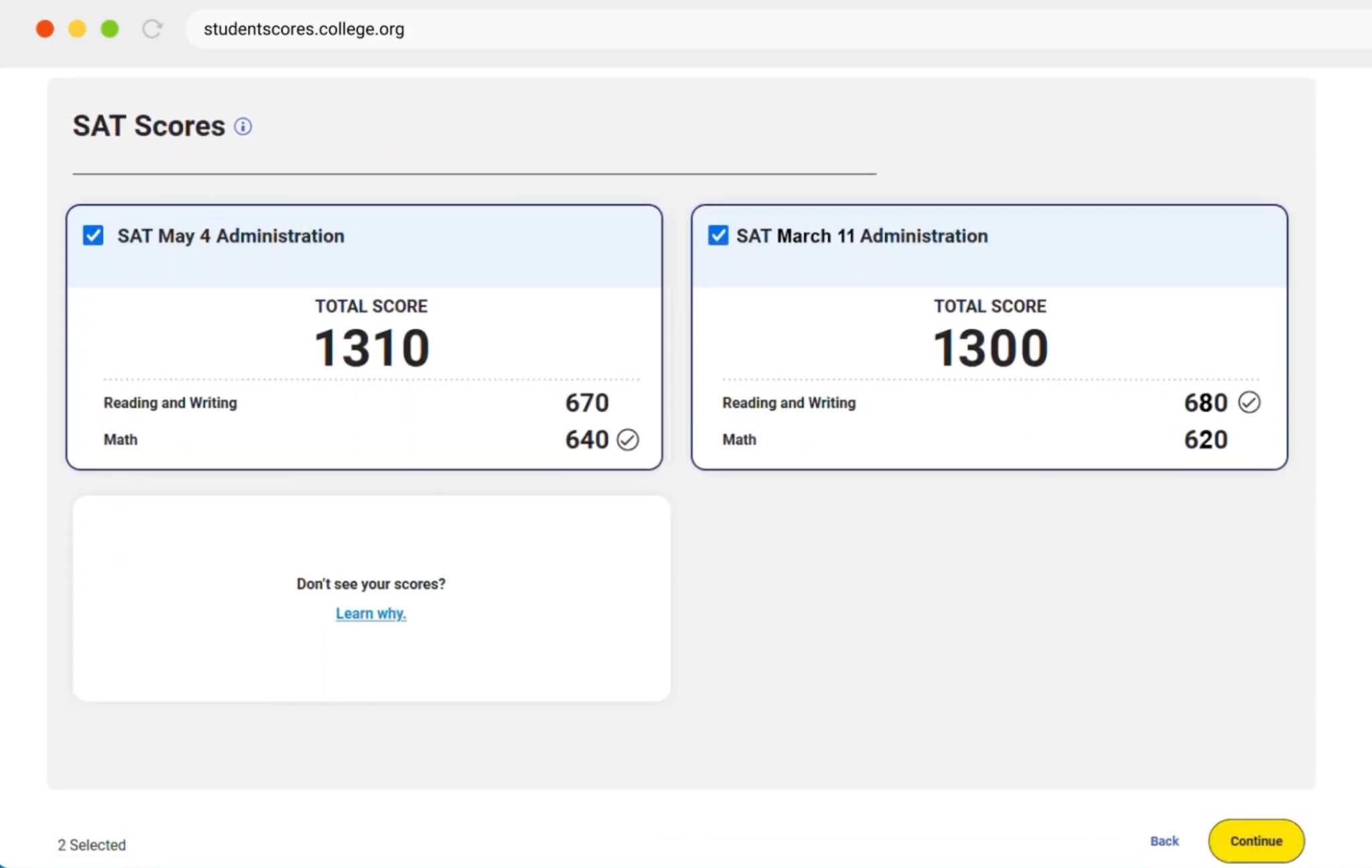
Source: College Board
With that being said, most schools that accept ACT superscores will also superscore the SAT (and vice versa). College Board’s website is explicit about the fact that SAT superscoring is very much a thing:
“Note: Some institutions use superscoring, which means they consider your highest section scores across multiple test dates.”
Source: College Board
Because of this, if you are submitting SAT results to a school that superscores, you should always submit scores from both the test date on which you earned your highest Math score AND the date on which you scored highest in Reading & Writing.
Wait, you said “a school that superscores”; does that imply there are some that don’t?
Excellent question, imaginary reader: yes. Though superscoring has become increasingly common in recent years, schools still employ a wide variety of policies when evaluating standardized test scores. These include…
Superscoring
“We will use an applicant's highest superscore, which means that we will consider the best sub-scores reported across multiple test dates, to make an applicant as competitive as possible. You may submit your scores as a superscore, but if you wish to have us calculate the superscore for you instead, you may submit all of your test scores.”
Source: University of Michigan Admissions
Using highest single composite score
“Penn State will use a student’s highest combined score from one single test date. Penn State does not utilize a superscore.”
Source: Penn State University Admissions
Requiring scores from all test dates
“Georgetown does not use the new ACT super score optional reports. Please send all individual ACT scores to our office from each ACT test administration as we are not a score choice school.”
Source: Georgetown University Admissions
Treating the SAT and ACT differently
“If you choose to submit scores: note that we allow superscoring of SAT test results, but we are unable to accept superscored results for the ACT exam due to the composite score included in the score report.”
Source: Carnegie Mellon University Admissions
When planning your applications, always do your own research. The best place to get information about a school’s admissions policies vis-a-vis standardized testing is straight from that school’s website. If you have questions about the information provided there, contact the admissions department directly for clarification.
I’ve done my research, and I know the standardized testing policies for the schools to which I’m applying. How does this affect my prep?
Regardless of testing policy, your overall approach to your first test date will pretty much always be the same: try to achieve the highest scores possible across the board. At the end of the day, if you hit your goal score on the first try, everything else is more or less academic.
If you do end up testing more than once—and many students do—the subsequent test dates are when testing policy might factor into your approach.
For instance, let’s say you take the SAT for the first time and get a 1350 (630 R&W, 720 M). If you’re exclusively applying to schools that superscore, it’s probably smart to slant your practice time heavily toward Reading & Writing as you prepare to test again. After all, you already have a strong Math score locked in, and there’s significantly more room for you to improve on the verbal half of the test.
On the other hand, if you know that some of the schools you’re applying to use the single highest composite score for admissions purposes, your distribution of prep time should be more evenly split between the two halves of the test. You’ll probably still want to put a bit more focus on R&W, as that’s clearly the area where you’re not as strong, but it’s important that you stay sharp on Math as well to ensure that your score doesn’t drop on the next test.
Understanding testing policies is an important part of optimizing your college application process; hopefully this post makes that wild and wonderful world feel more accessible to you. If you have any questions about superscoring or other testing policies, or you just want to shoot the breeze about the SAT or ACT, give us a shout; we’d love to help.