
PSAT Scores, Explained: What They Mean and Why They Matter
The PSAT is many things: practice for the SAT; an opportunity for students to qualify for a National Merit Scholarship; and an ingenious way for College Board to smuggle their testing suite into school systems.
But as widespread as this test is—with students across the country taking it in 10th and 11th grade, and some taking a different version in 8th and 9th as well—there’s a surprising amount of misinformation out there about PSAT scores.
In this post, we’ll correct some of the misconceptions about this test and help you understand how PSAT scores relate to SAT scores. Let’s dive in.
How is the PSAT scored?
Like its parent test, the PSAT consists of two sections: Reading & Writing and Math. Each section is broken up into two modules and is scored from 160 to 760, for a total composite score range of 320–1520 (slightly different from the SAT, which ranges from 400 to 1600).
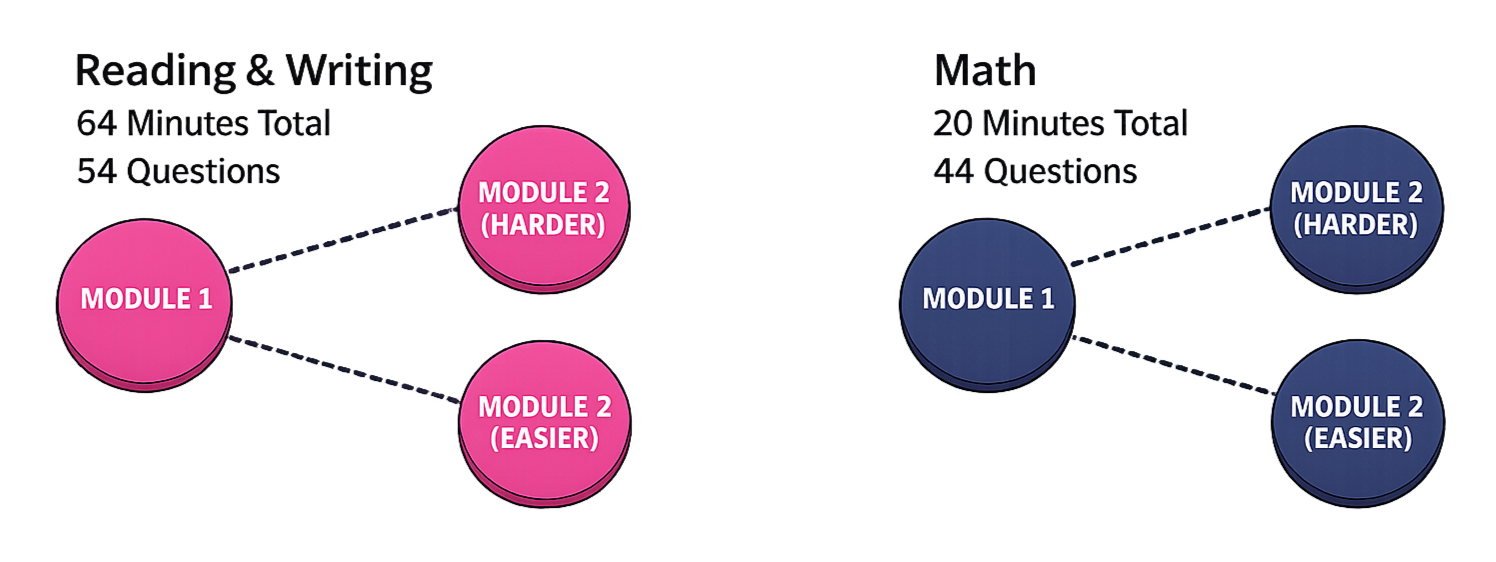
As is also the case with the SAT, the PSAT is a computer-adaptive test. Module 1 of each section will contain some harder questions and some easier questions, but overall it will average out to be approximately medium difficulty by the test’s standards. Then, based on your performance in Module 1, the PSAT algorithm will assign you either a harder version of Module 2 or an easier one, which will determine your final score in the section.
The easiest way to think of it is that Module 1 places you into a score band (say, 500–650) and then Module 2 determines where exactly in that band you fall. Your performance in Module 2 absolutely has an impact on your final score; however, your performance in Module 1 may mean that you are unable to score above or below a certain level in the section.
How does the PSAT compare to the SAT?
Structurally, the answer is pretty much just “yes”. The two tests are exactly the same length, both in terms of number of questions and time limit: you’ll have 64 minutes to complete a total of 54 questions in Reading & Writing and 70 minutes to complete 44 questions in Math.
The content is a bit of a different story. There is some definite overlap, in that the question-types and the concept areas tested are broadly the same in both sections across the two tests. For example, Math is divided up into problems dealing with:
Algebra
Advanced math
Geometry/Trigonometry
Problem-solving and data analysis
Reading & Writing, meanwhile, assesses:
Vocabulary knowledge in context
Reading comprehension
Logical reasoning
Grammar and rhetoric
Information synthesis
Beyond those similarities, though, lies the key separation between the two tests: the PSAT elides the hardest material and questions in each area, which makes it easier overall. If you were to compare them side by side, you would notice that the SAT contains harder vocab words, more advanced algebra concepts, and more challenging reading passages, among other differences.
How do PSAT scores relate to SAT scores?
This is the part of the conversation that generates the most confusion and misinformation. As mentioned above, the PSAT is scored on a scale from 320 to 1520, while SAT scores range from 400 to 1600. Because of this, many people think there’s some sort of conversion that must be done in order to compare PSAT scores to SAT scores, such as adding the 80 points that separate the two scoring scales.
That is not the case! The gap between the scoring scales on the two tests (called ‘vertical scaling’) is by design, and is intended to reflect the omission of the hardest SAT questions from the PSAT. In fact, the tests are crafted such that the scores are directly comparable, something that College Board is very explicit about:
“Suppose a student took a PSAT-related assessment and the SAT on the same day. With vertical scaling, they would be expected to get the same score on both tests. Vertical scaling makes it easier to understand what to expect from younger students when they reach college.”
Source: College Board
The only potential exception to this general principle is students scoring at or very near the top of the PSAT range. A student who earns a 1510 on the PSAT would have gotten almost every question on the test correct, which would indicate a high level of mastery of PSAT content—and therefore mastery of all but the most challenging content on the SAT.
It’s possible that such a student would also be comfortable with some or even all of the concepts not included on the PSAT but present on the SAT, which would allow them to potentially score higher on the SAT than they had the opportunity to demonstrate on the PSAT. Aside from that very specific case, though, it’s correct to view PSAT scores as an approximation of a student’s SAT scores at that point—while of course allowing for variance caused by factors like test-day conditions.
What sort of improvement can I expect from the PSAT to the SAT?
As you would expect, the answer to this question depends on a number of other factors.
Which set of PSAT scores (PSAT 10 or PSAT/NMSQT, taken in 11th grade) are you using as your baseline? Many students score higher on the PSAT/NMSQT than on the PSAT 10, likely because they have another year of school under their belts.
How many times are you planning to take the SAT? Most students improve their SAT scores with repeat testing due to increased familiarity with the test, a higher level of comfort with the testing environment, and additional preparation in the period between test administrations.
How much, and what kind, of preparation will you be doing for the SAT? There are a number of different ways that you can prepare for the SAT: independent prep, virtual or in-person prep classes, and small-group or 1-on-1 tutoring. Your mileage may vary as far as preferring one method to the others, but the most important thing is that students who practice for the SAT tend to do better than those who don’t.
Leaving aside those considerations, a study published by College Board in 2018 attempted to provide a general answer to this question by comparing the results of thousands of students on two different tests in the SAT suite and measuring their improvement. The final report is long, complex, and very dry (unless you’re a statistics nerd), but the (extremely) partial summary below provides a reference point for anyone looking for a quick, rough answer to this question:
| Starting Score Range (per section) | Average Improvement (per section) |
|---|---|
| 400–490 | 30–50 points |
| 500–590 | 20–40 points |
| 600–690 | 20–30 points |
| 700–760 | 10 points |
So a student who scored a 1200 on the PSAT in the fall of their junior year, for example, could expect to see approximately 60 points of improvement upon taking the SAT in the fall of their senior year.
Again, it’s important to note that this study did not control for amount or type of prep. It is very possible that you could see more (or less) improvement than this depending on how much work you put in!
Okay, so sum it up for me: how should I think about the PSAT?
For the vast majority of students, the PSAT should be viewed as an SAT practice test in an official setting. It provides exposure to the question-types and most of the content that will show up on the SAT, gives you practice with the Bluebook testing client that is used to administer both the PSAT and the SAT, and offers a helpful estimate of your current SAT score—no conversion needed.
A small subset of students can also earn the right to apply for a National Merit Scholarship based on their PSAT scores in 11th grade. The scores required to qualify are typically very high—especially in more densely populated states—so most students should set their sights on maximizing their SAT score and simply use the PSAT as one more step on the path towards that goal.