
Should You Take the SAT or ACT in 2026? How to Decide
The ACT and SAT have a lot in common. They're both three-letter test names that used to be acronyms but are now just brands; they both theoretically assess your knowledge of math concepts and language skills learned in school while actually testing your critical reasoning and pattern recognition as much if not more; and they are both supremely crappy ways to spend a Saturday morning.
For all their similarities, however, there are a number of notable differences between the two tests with regards to—among other things—structure, content, and timing. These differences make the decision of which test to prepare for a more important one than many students, parents, and counselors realize. In this post, I'll walk you through the best way to go about making that choice as efficiently as possible so you have more time to spend on… honestly, I'm too washed to even come up with a relevant reference. Let's just jump right in.
Step 1: Gathering Data
The first step of the process is also the most time-consuming: getting a sense of your natural affinity for each of the two tests. The easiest way to accomplish this is simply to get practice scores for both the SAT and the ACT and then compare them.
Fortunately, most high schools require students to take either the PSAT or the PreACT, and scores on each of those tests can be used as a proxy to predict performance on the corresponding "parent" test—so if you earned a 27 on a recent PreACT administration, you can assume that your score on the actual ACT would be roughly a 27 as well.
The bad news, however, is that many schools do not provide students with the opportunity to take both the PreACT and the PSAT; if that describes your school, you'll need to take a practice test in order to get a score for the test family that your school doesn't offer. Free practice tests can be found on both the College Board's website and ACT.org, so you won't need to spend any money to get this data; however, you should try to take the test in one sitting so that your starting score will be as accurate as possible, which means that you will be sacrificing 2-3 hours of time and a small amount of mental health.
Step 2: Comparing the Results
Once you have your hard-earned practice scores in hand, you'll need to compare them. The ACT is scored on a scale of 1-36, while SAT scores range from 400 to 1600, so there's not an obvious way to do this. Thankfully, College Board and ACT have published a set of concordance tables that allow college admissions staff to convert SAT scores to ACT scores and vice versa; we've reproduced a portion of the composite score conversion table below.
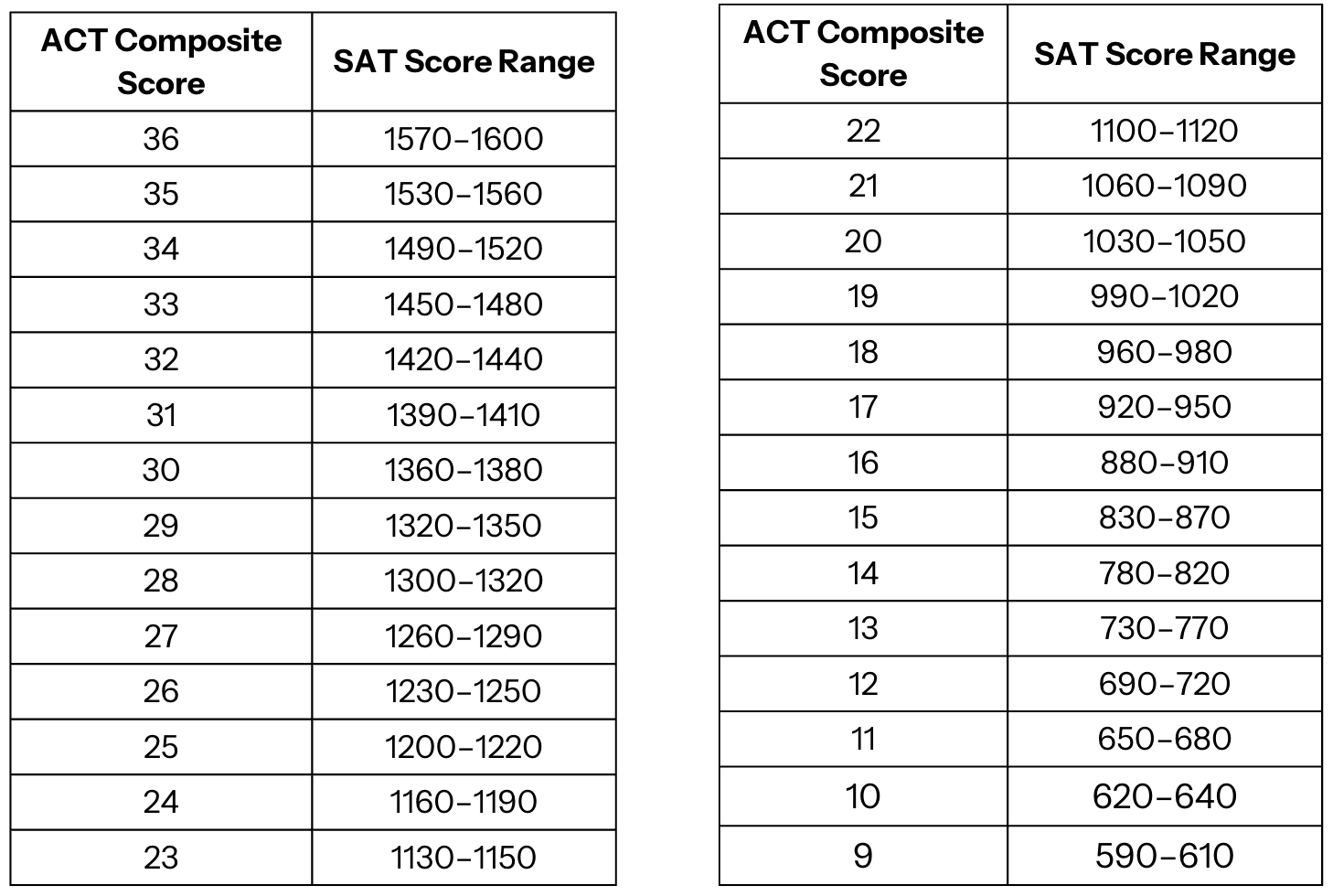
To use this chart, you'll simply take your composite score from one of the two tests, find the corresponding cell on the table, and convert it to the score range of the other test using the adjacent cell. So if you earned a 24 on your PreACT, for example, your corresponding SAT score range would be 1160-1190; you'd then compare that range to the score you earned on your SAT practice test.
Step 3: Making the Decision
A quick note on the new format: In April 2025, the ACT launched an "Enhanced" version of the test — shorter (~2 to 2.5 hours depending on whether you take the optional science section) with fewer questions per section. The SAT, meanwhile, went fully digital in 2024. All of the comparisons below reflect these current formats.
Evaluating Scores
When you have a sense of your relative starting position on the two tests, the final step is to figure out which one fits you best. Start by comparing your practice scores. Generally, we weigh differences between scores roughly as follows (after first converting a student's SAT results to the ACT scale):
1-point difference between the scores: This falls within the range of expected variance and therefore shouldn't play much of a role in your decision.
2-point difference between the scores: This counts as a pro in favor of the test with the higher score, but it isn't a hard-and-fast deciding factor.
3-point (or more) difference between the scores: This should be considered a pretty firm indicator that the test with the higher score is a better option for you, absent any significant extenuating factors (e.g. being sick when you took one of the tests).
If you scored significantly better on one test than on the other, congratulations: that test is likely to be the better choice for you, and you can stop reading now. If you're one of the large group of unlucky students whose scores are close enough so as not to provide a clear recommendation, it's time to weigh the differences between the SAT and ACT and determine which one is more likely to be conducive to your improvement.
Breaking the Tie
Remember the differences between the SAT and ACT that I mentioned earlier? Now's the part where we use those distinctions to make a decision as to which test you're likely to see the most improvement on in the shortest amount of time.
Speed vs. problem-solving: The ACT is a faster-paced exam than the SAT: students get 1.11 minutes per question in ACT Math and an average of .87 minutes per question in ACT English and Reading (with more given in Reading and less in English), compared to 1.59 minutes per question in SAT Math and 1.19 minutes per question in SAT Reading & Writing.
The flip side of this is that the average question on the SAT typically requires more from you. SAT Reading passages are more numerous, shorter, and often denser, and the questions ask students to engage with the text in more and different ways; conversely, the ACT Reading section is more a test of students' ability to retrieve information from longer passages at speed.
On the Math side, the ACT tests a wide range of content in what is generally a fairly superficial way, while SAT Math emphasizes flexible problem-solving and multi-step fluency with a smaller number of concepts.
If you're someone who highly values the ability to spend more time processing, even if the questions are more challenging overall, that's a point in favor of the SAT; on the other hand, if you can handle a bit more time pressure in exchange for fewer steps per question, you may be better suited for the ACT.
Stronger math student vs. stronger humanities student: This one is pretty straightforward: Math makes up ½ of the composite score on the SAT and only ⅓ of the composite score on the ACT. Though the two Math sections have differences, as described above, it's still worth noting that an especially strong math student is likely to feel comfortable with more of the questions on the SAT than on the ACT.
Vocabulary vs. grammar: Both tests assess vocabulary level and grammar knowledge, but to varying degrees and in different forms. Overall, the SAT puts more emphasis on vocabulary, while the ACT will require more comfort with grammar rules. If you're much better at one than the other, that's a point in favor of the corresponding test—particularly if it's vocab that is the weaker area for you, as vocabulary is very difficult to improve in a short period of time.
Flexible format and plenty of practice material vs… not those things: The final notable factors to consider are external ones: test format and ease of prep. Though both tests have undergone significant changes in recent years, the new ACT is much closer to the old ACT than the new SAT is to the old SAT. As a result, most "outdated" ACT prep materials, both official and third-party, are still totally valid tools to help you prepare. The SAT provides some practice material through the Bluebook tests and Educator Question Bank, but overall there's still more content available for the ACT—a consideration for students who benefit from additional reps with test questions.
On the formatting side, the ACT is still available in both digital and paper-and-pencil forms, while the SAT is solely digital. This isn't a massive factor for most students, especially given the bevy of online tools seeing use in classrooms across the country since COVID, but it is worth considering for students who place a high value on annotating in the margins of a Reading passage, for instance.
Overall, while these external factors should not be the main impetus for your decision by any means, they do constitute a point in favor of the ACT, particularly for students who are still torn between the two tests after weighing all other elements.
Step 4: Preparing for the Test
While starting with the correct test is preferable, it's important to remember that this is just the first step of a longer process—one that will not be defined solely by the choice you make now. With the right techniques and enough practice, you can improve your score significantly on either the SAT or the ACT. Additionally, though it's not ideal, you can change course during the process and begin prepping for the other test instead if you aren't seeing the progress you want.
Whichever path you choose, the core tenets of score improvement hold true across both tests: practice, learn from your mistakes, and then practice some more. And if you're looking for support or guidance during any part of the process, we know some people who can help.