
SAT Reading & Writing: Tips, Tricks, and Techniques to Get You Started
SAT Reading & Writing is something of a grab-bag of sadness—the answer to the question, “how many things that students hate can we fit into one test section?” Composed of a variety of question-types and requiring a diverse blend of skills, SAT R&W is split into two 27-question modules, with testers given 32 minutes to complete each one.
With its mix of vocabulary, grammar, and reading comprehension (plus a few graphs and charts thrown in for good measure), this section can feel difficult to get your arms around. And make no mistake: maximizing your score will require practice, practice, and more practice. We’re here to get you started on the right foot with some of the most fundamental tips, tricks, and techniques for SAT Reading & Writing; let’s dive in.
Tip 1: Know the Section Layout, and Plan Accordingly
If you read our post about SAT Math, this first tip will look pretty familiar. As important as knowing the section layout is on that half of the test, though, it’s even more essential here. That’s due primarily to the number of distinct question-types and how different they are from each other.
I divide this section up as follows:
Sentence completion questions: Students are given 1-2 sentences with one word/phrase removed and tasked with selecting the word/phrase that makes the sentence(s) most logical.
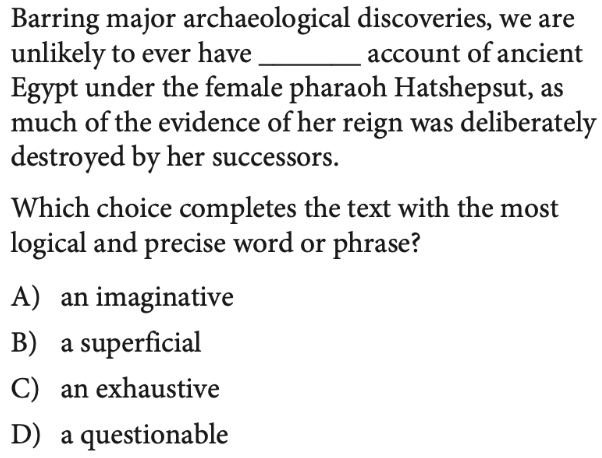
Source: collegeboard.org, Practice Test 10
Text and graph questions: This portion of the section comes in a variety of different subtypes, but all questions include a paragraph of text and assess students on their ability to comprehend, analyze, and make inferences from that short passage. Some also include a graph or a chart, because why the hell not.
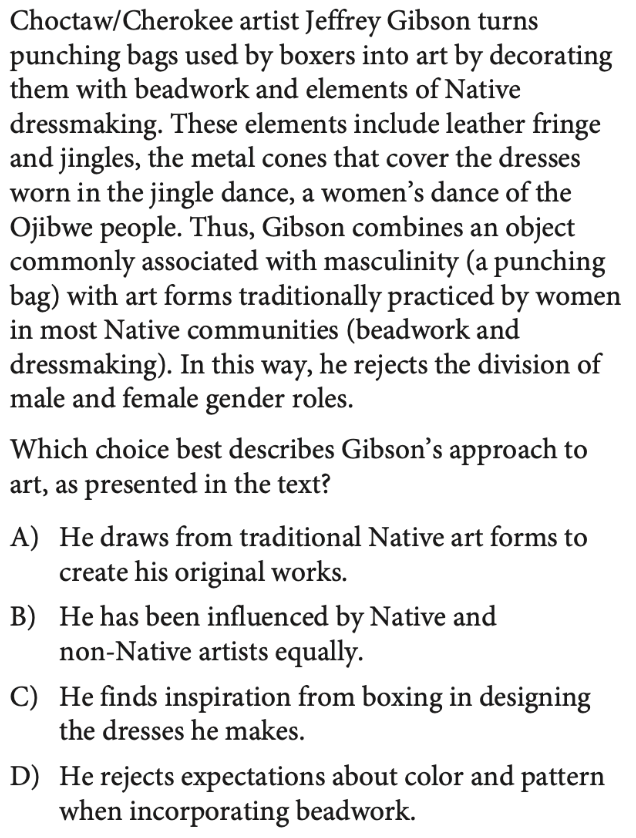
Source: collegeboard.org, Practice Test 10
Grammar mechanics questions: On these questions, students are again faced with 1-2 sentences that include an omitted portion; in this case, however, they are required to fill in that blank with the grammatically correct construction from among the choices offered.
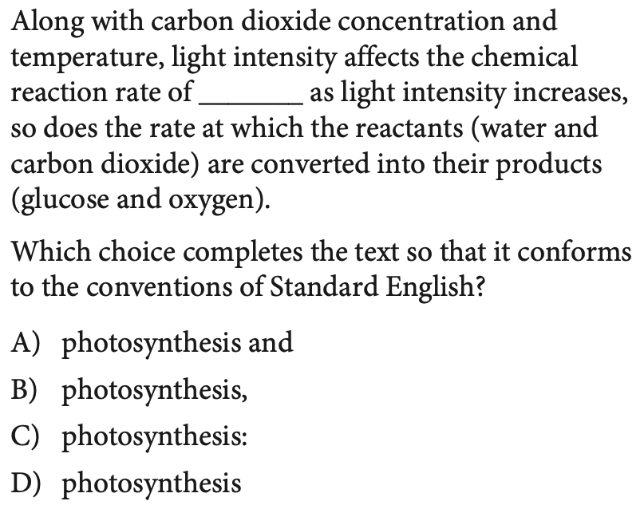
Source: collegeboard.org, Practice Test 10
Transition questions: Very similar in structure to grammar mechanics questions, these problems ask students to complete the sentence(s) with the transition word/phrase that most logically connects the ideas presented.
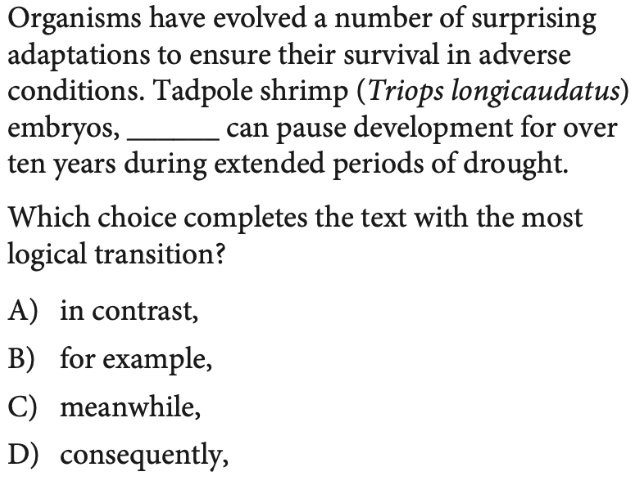
Source: collegeboard.org, Practice Test 10
Notes synthesis questions: Without a doubt the most unique part of the section, notes synthesis questions present students with 4-7 bullet points’ worth of information on a topic and challenge them to extract the most relevant elements in order to accomplish a given objective.
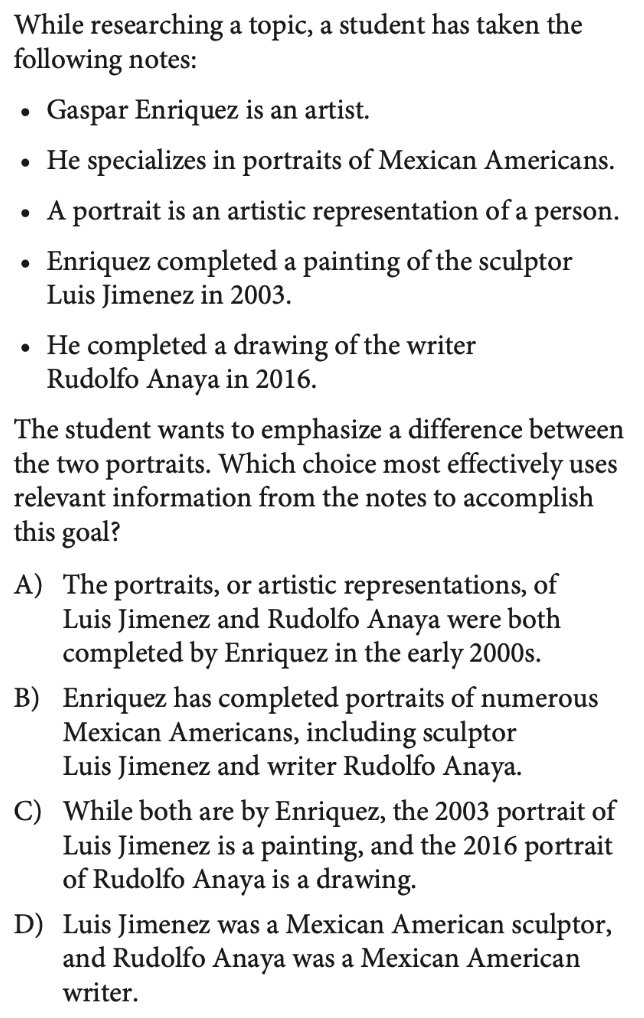
Source: collegeboard.org, Practice Test 10
Unsurprisingly, most students find that different question-types typically take them different amounts of time to complete: grammar questions are often among the shortest in terms of average time spent per question, for instance, while text and graph questions often require significantly more time.
Thankfully, the significant differences between the various elements of this section are tempered somewhat by a consistency of sequence: these question-types will always show up in the same order and in roughly the same proportions. That consistency is hugely important when it comes to pacing yourself in the section, as it allows you to prioritize the question-types with which you’re most comfortable.
For example, many students benefit from saving the text and graph questions for last, front-loading the problems that have the smallest ratio of time spent to point gained; this maximizes efficiency and ensures that when they do get to those longer questions, they can approach them knowing exactly how much of their remaining time they have to allot to each one.
Tip 2: Read the Question First
This is an easy one, and it’s pretty intuitive for most students. With a number of different question-types—many of which look very similar—and a limited amount of time to address them all, it’s important that you know what you should be looking for in a passage before you start reading it. A sentence completion question requires you to hunt for context clues that provide hints as to what the definition of the missing word is; for a grammar mechanics question, on the other hand, you might need to be on the lookout for verb tenses or pronoun antecedents.
This is even true between the subcategories of text and graph questions. The way that you read a passage when trying to identify the author’s main point will be very different from the way you approach a text when you’re being asked a detail-based question about a specific part of the paragraph. Know what you’re looking for before you start reading in order to maximize your efficiency and make the most of your time.
Tip 3: Read Carefully, and Read Enough
Students are always looking for shortcuts, and in SAT Reading & Writing that often manifests in a desire to read as little of the text as possible. While there are a few places where your default strategy can be to read less (on notes synthesis questions, for example, you don’t need to read the bullet points until you’ve first confirmed that there is more than one answer choice that accomplishes the given objective effectively), by and large you should be careful not to cut corners. Context matters, and most of the passages you’ll be dealing with are fairly short, which means that there typically isn’t much fluff that can be safely disregarded.
And when you are reading, it’s imperative that you do so carefully. This applies to the passages themselves, of course, but also to the answer choices. One of the SAT’s favorite tricks in text and graph questions is to give you a long answer choice where the first 90% of it lines up very well with the passage and the question; it’s not until the very end of the choice that there’s a word or phrase which invalidates the whole thing. If you’re not paying attention, or if you tune out halfway through because you’re thinking that you’ve found the right answer, you’ll fall into this trap every time.
Tip 4: Take Small Bites and Chew Your Food
No, not literally. Well, yes, literally as well—otherwise, you’re weird and gross and probably setting yourself up for health problems down the line. I’m talking here in terms of reading, though.
One of the biggest obstacles in this section is the questions accompanied by more complex passages. Shakespeare, Jane Austen, Edith Wharton—the SAT pulls no punches when it wants to make passages challenging. And that’s not even accounting for the non-fiction texts, which can be just as dense and opaque.
There’s no magic wand you can wave to make these passages more accessible (the closest thing is doing as much independent reading as you can of similar material), but a good place to start is by breaking the text up into small portions and pausing as you go to analyze. Look for logical stopping points in the passage, such as punctuation or transition words, and use them as prompts to take a second to think about what you just read. How would you explain it to someone in your own words? And how does it build on the earlier portions of the passage?
Don’t try to read and understand an entire brick of Emily Bronte’s prose in one go; that’s a recipe for getting to the end of the paragraph, realizing you have no idea what you just read, and being forced to start from the beginning. Take it one piece at a time, and try to build your understanding of the passage gradually as you work your way through it.
Tip 5: Be Literal
Our final tip, like the previous one, applies primarily to the text and graph questions. Remember: reading comprehension is not black and white in the same way as algebra or grammar. If you try to tell your English teacher that there’s only one way to interpret a piece of text, they’ll probably smack you with the nearest copy of For Whom the Bell Tolls. So how does College Board create objective reading comp questions for the SAT?
The answer is that they remove as much interpretation as possible. By sticking to what the text says directly rather than asking about allegories or underlying themes, they’re able to create questions that have only one correct answer. This means that if you’re debating between two answers, your primary tiebreaker should be how literally and directly connected to the passage each choice is. Which one requires you to do the least amount of work to justify it? For which choice can you point to something in the passage to support every part of it?
If you catch yourself making assumptions or saying words like “maybe” or “probably” as you’re rationalizing an answer choice, there’s a good chance you’ve strayed too far from the source material. Pump the brakes, refocus on the text, and try again.
- - - - - - - - - - - - - - - - - - - -
With its diversity of questions and emphasis on critical thinking, SAT Reading & Writing asks a lot from you, which can make the section feel very imposing. The flip side of that, though, is that you can improve your score without mastering every single concept. If you’re someone who can’t memorize comma rules to save your life, you can still get better in this section by focusing on reading and analyzing passages more effectively; if you hate hard fiction passages, you can still nail the transition questions.
Take it one step at a time, and don’t let this section overwhelm you. And if you’re looking for help getting started, you know where to find us.