
ACT English Tips: 4 Strategies to Improve Your Score
The first obstacle you'll face when you sit down and—excitedly, I can only assume—open your test booklet to take the ACT is the English section. English is the first of the three mandatory sections on the test, with the fourth and final portion being the optional Science section.
English is an intimidating part of the ACT for many students, due primarily to a combination of A) the fact that they assume scoring well on the section will require an encyclopedic knowledge of grammar rules and B) the decision that was apparently made by US high schools sometime in the last 10-15 years to stop teaching those grammar rules, like, at all.
If you're one of those students who almost passes out when they see a semicolon, I have good news and bad news. The bad news is that to master this section you will indeed have to learn some grammar. The good news, though, is that you won't have to learn nearly as many rules as you probably assume, and that much of the section doesn't even test those rules.
So calm yourself, grab a glass of water, and have a quick lie down if you need it; then, it's time to dive into some foundational tips and tricks to help you improve on the ACT English section.
Tip 1: Know Your Enemy
It may seem basic, but knowing what you're walking into is the first part of success in ACT English. As of the Enhanced ACT, which launched digitally in April 2025 and rolled out nationally in September 2025, the English section now consists of 50 questions that must be answered in 35 minutes. The questions are interspersed throughout five different passages, which are each 3-5 paragraphs long.
There are two main reasons the structure of the section is important. First, the layout can be confusing if you're not prepared for it. Some portions of sentences and paragraphs will be underlined while others won't, and there will sometimes be large gaps between lines of text to accommodate corresponding questions, as seen in the section excerpt below.
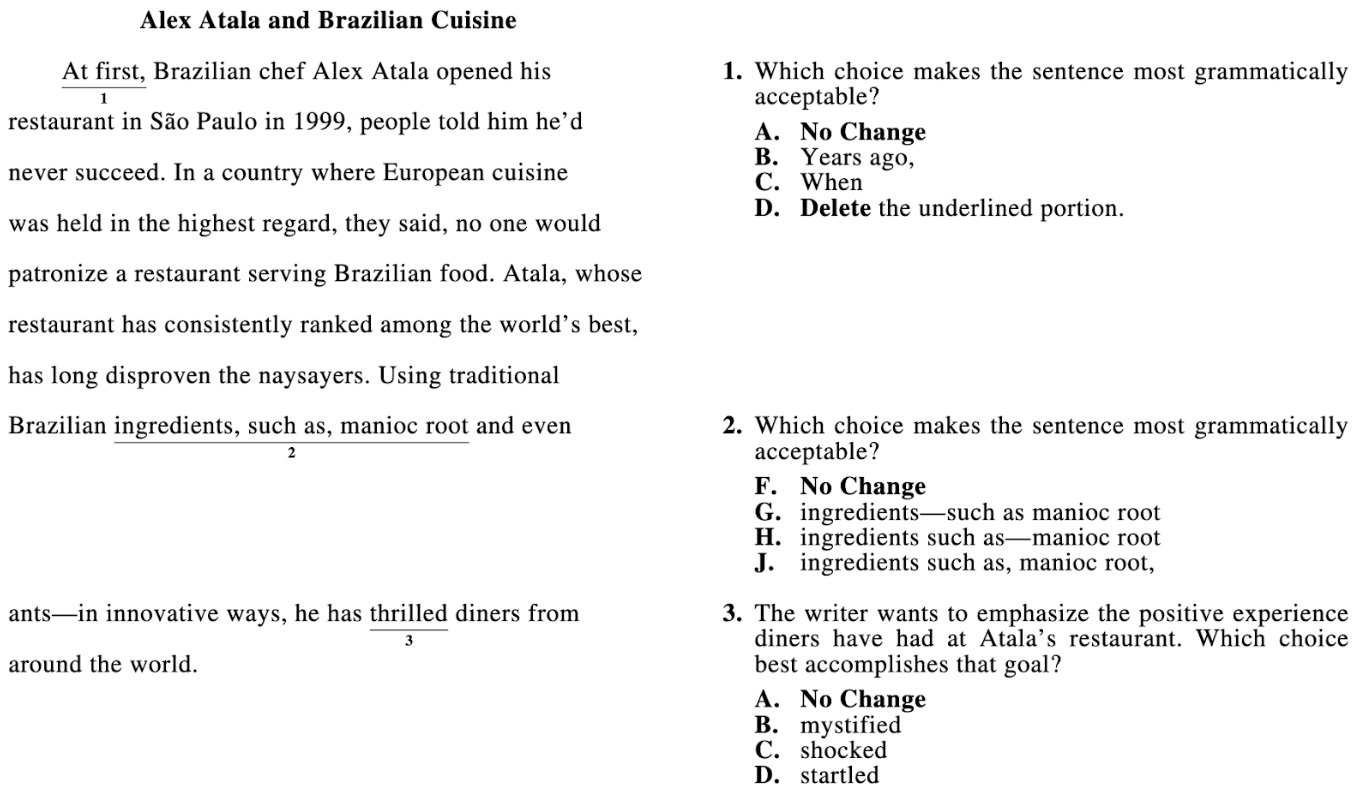
Source: ACT.org, Practice Test 1
You'll need to be fully prepared to navigate the section's formatting quirks confidently and efficiently: with an average of only 42 seconds allotted for each question, you don't have time to spare for confusion or disorientation.
Second, the English section requires more reading than many students expect. Because each question refers to a sentence—or sentences—that is part of a larger passage, context is sometimes needed to determine which answer is best. We'll talk about this in more detail later on.
Tip 2: Read the Questions
Yes, this should be obvious. After all, it's hard to answer a question correctly if you don't know what it's asking. But because students are often rushing, and because many of the questions in ACT English share the same wording and format, it is very common to see a test-taker accidentally go on autopilot, assume they know what a question is looking for without reading it carefully, and pick the wrong answer as a result.
I divide this section up into two general categories of questions:
- Grammar mechanics: These problems test your knowledge of those annoying grammar rules we mentioned earlier. They're easily identifiable because they're all framed the same way: "Which choice makes the sentence most grammatically acceptable?"
- Rhetoric: Rhetoric questions test your ability to assess and improve the quality of an author's writing rather than the accuracy of their grammar, and they come in a number of different flavors. The main subtypes include…
- Concision questions ("Which choice is least redundant in context?")
- Vocabulary-in-context questions ("Which choice is clearest and most precise in context?")
- Tone questions ("Which choice most effectively maintains the essay's tone?")
- Transition questions ("Which transition word or phrase is most logical in context?")
- Ordering sentences in a paragraph or paragraphs in the essay ("Which sequence of ______ makes the ______ most logical?")
- Specific objective questions (Can take many different forms and are often specific to the individual passage)
With the different variations of questions laid out like this, it should be easy to see why reading carefully is essential. If you're tasked with picking the choice that "creates the clearest contrast", for example, but you think you're just answering a simple grammar question, at best you'll lose valuable time being confused and at worst you'll simply get the question wrong because you don't understand it.
Tip 3: Read the Answers
The good thing about grammar mechanics questions' sharing the same wording is that they're easy to identify; the downside, however, is that the text of a given question does not tell you what specific concept it's testing.
This is a big deal, because most grammar questions will test only one topic. And although the body of grammar knowledge tested by this section isn't enormous—approximately 5-7 main concepts—you don't want to waste valuable time reading a sentence multiple times looking for a type of mistake that isn't there.
The easiest way to quickly determine what a grammar mechanics question is testing, and therefore what grammatical "filter" to use when reading the corresponding sentence, is to compare the answer choices and look for what's changing. For example, if the answers look like this…
- the field, players
- the field and players
- the field; players
- the field; where players
…you would notice that the differences between them are punctuation usage and choice/absence of linking word. This tells you that the question is almost certainly testing your ability to diagnose the anatomy of the clauses in the sentence (independent versus dependent) and connect them appropriately. As a result, you now know what to look for when you read the sentence and what sorts of things you shouldn't be worried about, such as the tenses of the verbs.
Tip 4: Read the Passages
Our final fundamental tip for the ACT English section concerns the importance of context. As I alluded to earlier, you will sometimes need information from surrounding sentences or even paragraphs to answer a question correctly, and it's essential to your success in this section that you anticipate and address that need.
Transition questions are a great example. If you're being asked to select the most logical transition word or phrase to connect two parts of a passage, it's very difficult for you to do that without first understanding what ideas you're connecting. Re-read the 2-3 sentences before the underlined portion and then look ahead to the 2-3 sentences after the underlined portion to ensure that you have the required context to answer the question.
This rule even applies to grammar mechanics questions, albeit to a lesser extent. One of the ACT's favorite tricks in these problems is adding something to the end of a sentence that affects the beginning, or vice versa. A prime example is the em dash (—). This piece of punctuation can be used alone (in which case it functions similarly to a colon) or in pairs (when they serve to bracket a piece of additional information, much like double commas or parentheses).
As such, if you see an answer choice with an em dash, it's imperative that you establish whether it's acting alone or it has a friend elsewhere in the sentence. A good rule of thumb for grammar mechanics questions is to read from period to period before answering the question. This will guarantee that you have all the relevant syntactical information to determine the right answer.
As this guide hopefully makes clear, you can improve your score in the ACT English section without memorizing 462 comma rules; indeed, you don't even need to do that in order to get a perfect score on the section.
Instead, focus on building your understanding of the 5-7 core grammar concepts that come up repeatedly in various forms and taking advantage of the patterns inherent in the section to approach each question optimally. Hopefully this post gives you a good starting point for doing just that—and if you're looking for 1:1 support with English or any other part of the ACT, you know where to find us.