
ACT Math Tips: 4 Strategies to Improve Your Score
Made up of 45 questions, ACT Math is almost exactly as long as its counterpart on the SAT. Aside from that structural similarity, though, the two sections are very different: ACT Math is faster-paced and tests a wider range of content than SAT Math, but the average question requires less problem-solving and fewer steps’ worth of mechanics.
The two sections do share one key characteristic, however: they have patterns that can be exploited to give you a leg up in the quest to boost your score. In this post, we’ll tackle some of the most fundamental tips and tricks to make ACT Math feel more manageable. Let’s dive in.
Tip 1: It’s Not One Long Section, It’s Three Short Sections in a Trenchcoat
Math is unique among the sections on the ACT in that it scales in terms of difficulty. This doesn’t necessarily mean that question #31 will be harder than #30, which is harder than #29, etc.—one of the ACT’s favorite tricks is to put a few difficult questions earlier in the section than they should be located, with the goal of intimidating you and throwing off your rhythm. It does mean, though, that #36–45 will feel noticeably more difficult on average than #1–10.
This adds a complicating factor to your pacing in ACT Math. If you treat it as one big blob of 45 questions that must be completed in 50 minutes, it’s very easy to misjudge your pacing early on, which can result in the need to rush through the later questions. Add to this the fact that those harder later questions typically require more time to complete and you get a sense of the structural challenges posed by this section.
One of the best ways to combat this is to divide the section into three mini-sections: questions #1–15, #16–30, and #31–45. On average, the first subsection will be the easiest and the third will be the hardest; by giving yourself a proportional time limit for each one, you can ensure that you’re staying on pace as you progress through the section.
I start most of my students out with a 15-17-18 split (15 minutes for the first subsection, 17 for the second, and 18 for the third), which accounts for the increased difficulty at the end of the section while still allowing at least a minute per question throughout.
Some students may find that they can move quickly and accurately enough at the beginning of the section to complete #1–15 in 13–14 minutes, leaving more time for the harder questions; conversely, students with lower starting scores may be better off allowing more time for the first two-thirds of the section so they can prioritize getting as many points as possible on the easy- and medium-level questions. Try out different distributions during your practice and find the one that’s optimal for you.
Tip 2: Know Math
Revolutionary, I know. But joking aside, this is a legitimate piece of advice with two components.
First of all, as I mentioned above, the range of content tested on ACT Math is wider than that on the SAT. Whereas the vast majority of the questions on the SAT deal with content students will have seen by the end of Algebra II, ACT Math touches on topics that often aren’t introduced until Precalculus. Even though some of these questions can be answered via ‘side door’ methods, such as calculator trial-and-error or plugging in—more on those shortly—you should still expect that you’ll need to be familiar with a number of advanced concepts if you’re aiming for a high ACT Math score.
The second part of this tip concerns memorization. Unlike the SAT, which gives students an equation bank built into the testing client, the ACT provides no reference information for you to consult while navigating the Math section. You’ll need to have commonly tested concepts like special right triangle ratios memorized in order to be fully prepared.
One of the best ways to do this is to create a reference resource for yourself during the prep process. Whenever you get a question wrong in a practice Math section, look up any formulas or rules relevant to that problem and add them to a Google Doc or Quizlet. Then, make a point of reviewing that document regularly as you prepare for the test.
Tip 3: Use Your Calculator Often, But Not Constantly
You’ll have access to a calculator for the entirety of ACT Math, and using it efficiently and effectively is one of the best ways to set yourself up for success in the section. There are a number of topics which the ACT tends to test in ways that lend themselves to graphing/scientific calculator shortcuts.
A few examples:
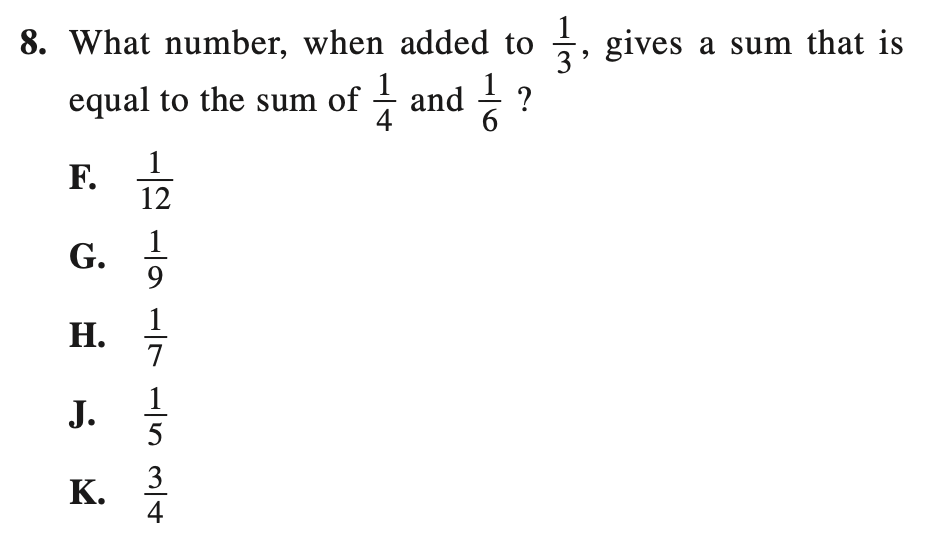
Fraction arithmetic/comparisons: The easiest way to do math with fractions is in your calculator; the easiest way to compare fractions and determine which one is biggest is to convert them to decimals using your calculator.
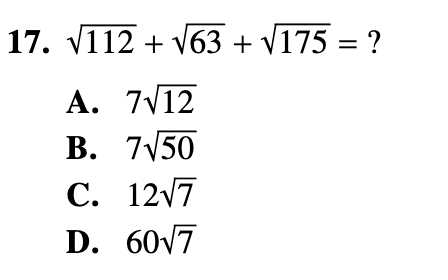
Evaluating exponents/roots: You can find the decimal value of these in your calculator, then find the decimal value of each answer choice and compare.
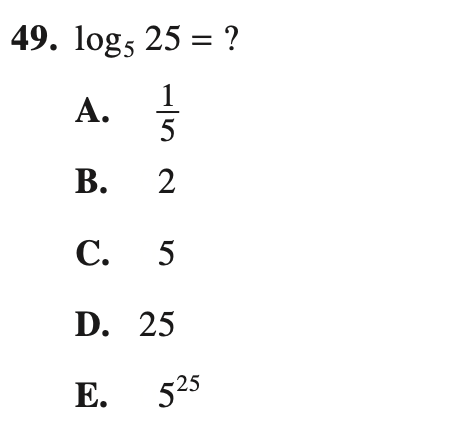
Logarithms: Most modern calculators have a ‘log base X’ function, which can save you time and effort on basic logarithm questions.
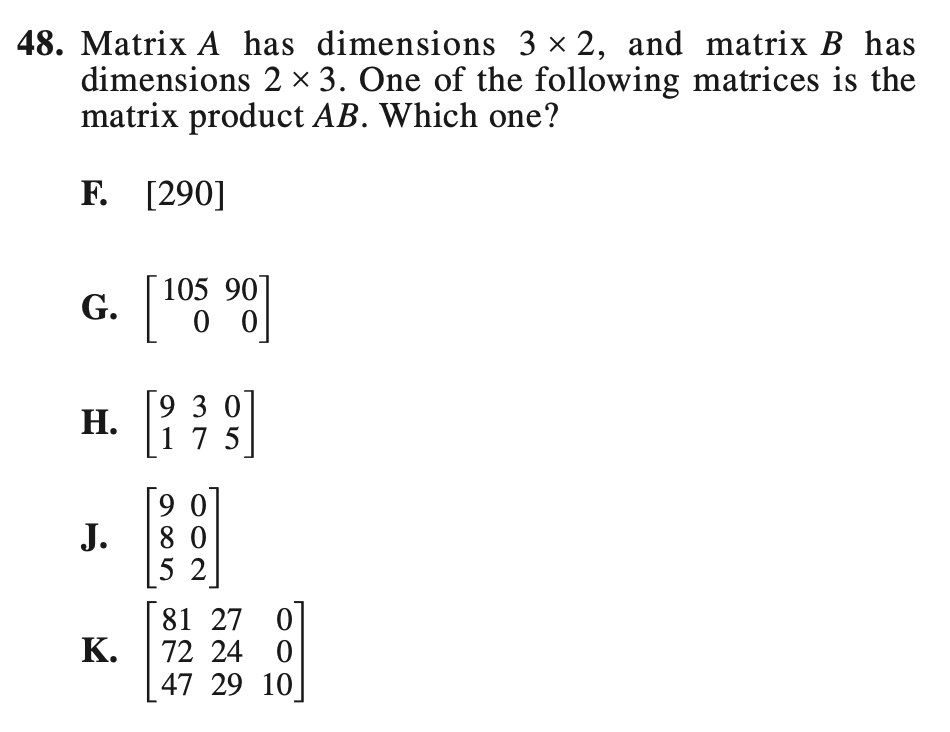
Matrices: Matrix addition and subtraction are very easy and intuitive to do by hand; matrix multiplication, however, is better done in your calculator unless you’re a wiz at doing it manually.
You’ll absolutely encounter others as well, so keep an eye out as you’re working through practice sections.
In addition to a handheld calculator, students taking the online ACT will also have access to the Desmos graphing calculator via a pop-out interface within the testing client. For the most part, your handheld calculator can do everything that Desmos can; however, there are certain things—mostly related to graphing—that are typically faster to do using Desmos.
Here are some of the areas where Desmos tends to be a time-saver above and beyond the standard handheld graphing calculator:
Systems of equations: It’s almost always faster to solve these by graphing rather than by using algebra.
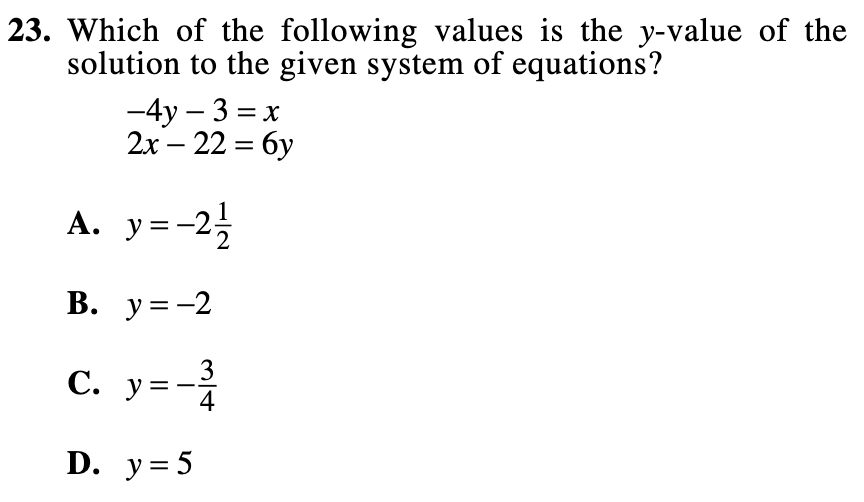
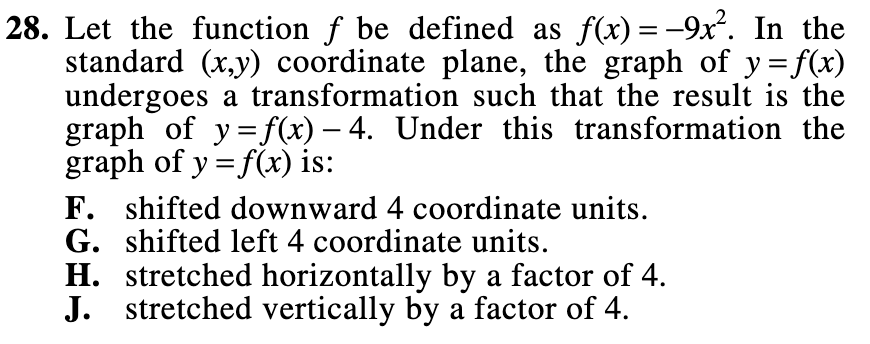
Function transformations: Define your function in Desmos, then apply the transformation to it and use that graph to answer the question.
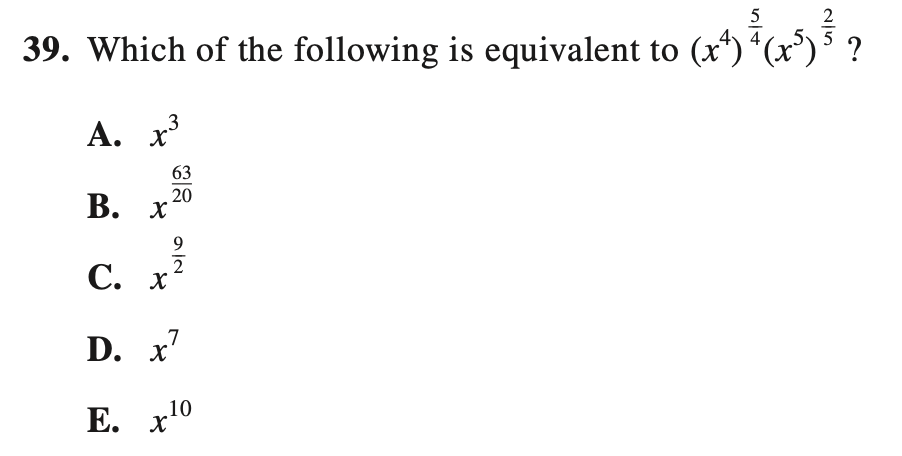
Equivalent expressions: If two expressions are equivalent, they will produce the same graph. Compare the expression in the problem to the expression in each answer choice and see which one matches.
Regardless of which calculator you’re using, it’s important not to overuse it. If you’re constantly turning to your TI or Casio just to “double-check” the product of 3 and 5, you may actually end up slowing yourself down overall. Strive to find a balance between taking advantage of the calculator’s greater efficiency in many areas and trusting yourself when it comes to basic calculations.
Tip 4: Look for Opportunities to Plug In
Our final foundational tip for the ACT Math section concerns every tutor’s favorite technique: plug-ins. There are two basic types of plug-in strategy.
Answer plug-ins are best used when the question is asking you to find a single numerical quantity, such as the value of a variable.
Ex: If \( 4(x-2)^{2} + 11 = 5x \), what is a possible value of \( x \)?
A) \( -2 \)
B) \( 0 \)
C) \( \frac{5}{4} \)
D) \( \frac{9}{4} \)
We can solve this algebraically, and that may even be the fastest way to answer the question if you’re a black belt in algebra; however, we can also plug the number in each answer choice in for x in the question equation, do some quick math, and find the number that balances the equation.
Variable plug-ins can be applied to questions where the answer depends on the value of a particular variable.
Ex: Which of the following expressions is equivalent to \( (y-5)^{3} \)?
A) \( y^{3}+15y^{2}+75y-125 \)
B) \( y^{3}+15y^{2}-75y-125 \)
C) \( y^{3}-15y^{2}+75y-125 \)
D) \( y^{3}-15y^{2}-75y-125 \)
Again, we can use our flawless algebra mechanics to rewrite the question expression in the form of the answer expressions and then compare them. Some students, though, might find it easier to take an alternate route and do some plugging in.
To start, we need to recognize that we’re given no restrictions on the value of our variable y. This means that we can plug in our own number—say, 2—and evaluate the question expression using that input:
\[ ((2)-5)^{3} = (-3)^{3} = -27 \]
Then, we’ll compare that result to what we get when we plug 2 into each answer expression for y. Whichever answer expression is equivalent to the question expression will produce the same output when given the same input:
\[ \text{C)} \quad (2)^{3}-15(2)^{2}+75(2)-125 = 8-60+150-125 = \mathbf{-27} \]
The end result is that we can earn a point on this question without doing a bit of algebra.
For many students, Math is one of the most imposing sections on the ACT, and the wide array of concepts tested can indeed make it challenging to master. Though the content tested tops out at some fairly advanced material, the bulk of the section is devoted to more basic algebra and geometry concepts. It’s very possible to make noticeable improvement in this section by focusing on those core concepts and using some of the ‘side door’ techniques discussed above to take advantage of the patterns inherent to the section.
Start with the fundamentals, and don’t let the scale of this section intimidate you. And if you’re looking for help getting started, you know where to find us.