
The ACT Science Section in 2026: What You Need to Know
When the ACT was reworked—sorry, “enhanced”—in 2025, the test-writers changed a number of things about the Science section. The time limit increased from 35 minutes to 40 minutes, the number of passages changed from six to seven (though the number of questions stayed constant at 40), and the section score was removed from the calculation of the composite score (more on this later).
What didn’t change, however, is the fact that this section is not intended to test your science knowledge. While you’ll see a few questions on the average section that require familiarity with some scientific concept, the vast majority of the questions are assessing your ability to synthesize scientific information from several provided sources and then answer corresponding questions, all while under time pressure. (See? Much easier!)
Even if you know that going in, though, it’s still very easy to get overwhelmed by the wall of information you’re faced with when you turn to Passage I in your test booklet. Fortunately, we’re here with some of the most important tips and tricks to make ACT Science feel less imposing. Let’s get started.
Tip 1: Make Sure You Actually Need to Take the Thing
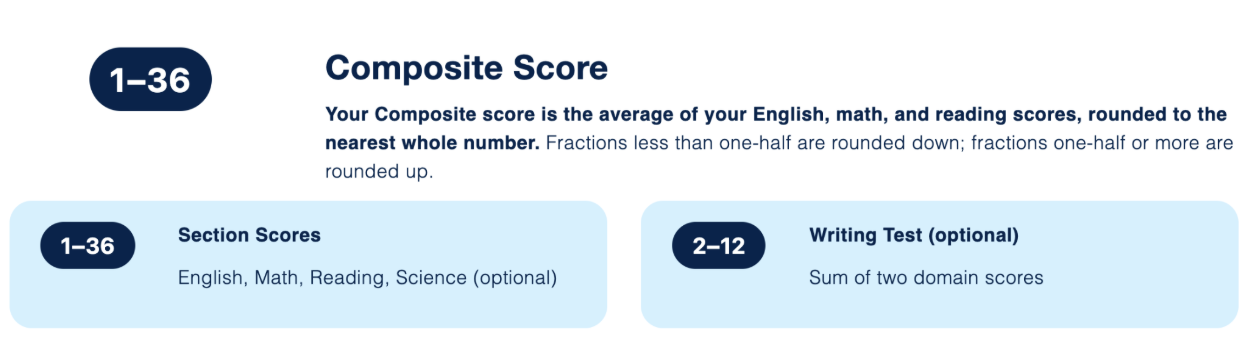
As I mentioned above, the Science section is no longer factored in when your ACT composite score is calculated; your composite is now the average of your scores in English, Math, and Reading, while Science receives an individual score that is displayed separately on your score report.
The reason for this is that as of 2025, Science is now an optional section. Much like the ACT Writing section, you can simply sign up to take the test without Science during the registration process. If you choose to forgo Science, your test session will end after the Reading section, and you’ll only receive scores for those first three sections (as well as a composite score).
Source: ACT.org
So why would you ever opt into taking this section? As of the time of writing, it’s not totally clear yet how many colleges view submitting a Science score with your application as truly optional and how many look at it as “optional”. Even if none of the schools to which you’re applying will deprioritize a Science-less application, it may make you stand out more to submit a high Science score—particularly if you’re applying directly into a STEM program.
The bottom line is that you should do your research before registering for the ACT. Make a list of the schools to which you know you want to apply, then check the Admissions portions of their websites to see what they say about ACT Science. Talk to your college counselor about whether it could potentially benefit you to have a Science score on record. Then, if you’re officially planning to take the section at least once, come back and keep reading.
Tip 2: Be Question-centric, Not Passage-centric
Loyal and attentive reader that you are, you undoubtedly noticed that this tip looks very similar to one from my ACT Reading post. That’s not a coincidence: the philosophy in that section is very similar to the one for Science.
In both cases, the ACT is trying to mind-game you into thinking that you have to read and comprehend the entire passage’s worth of information before you can start answering the questions. And in both cases, the section is paced such that you’ll likely run out of time if you try to approach it in that way.
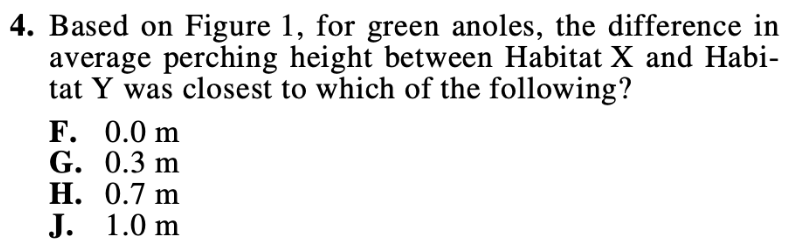
In reality, many of the questions in Science can be answered using information from one graph or chart and absolutely zero information from the passage. Take the example below:
Source: ACT.org
Reading this problem without any context, you probably have a number of questions. What’s an anole? What are they perching on? How did they get up there? Do they come in other colors? Why do scientists and mathematicians love the letters X and Y so much? Would it kill them to give Q and R some shine?
Even with those pressing queries burning a hole in your brain, you can probably also imagine that this would be a pretty easy problem to answer. It tells us where to look (Figure 1), it tells us what piece of information to look for (difference in perching height), and the answer choices are straightforward enough that we would probably be able to pull that information from the figure relatively quickly.
So don’t assume that you need to know everything for every question. When you start a passage, go straight to the questions instead of beginning by reading the text; then, for each problem, ascertain what information you need to answer it, determine where in the passage you’re most likely to find that information, and go get it.
Tip 3: Don’t Be Afraid to Read When Necessary
With all that said, there will be questions that require you to do some reading, so don’t feel like you’re not allowed to utilize the text at all! The key is being able to tell when you need more information than the graph or chart provides in order to answer a given question.
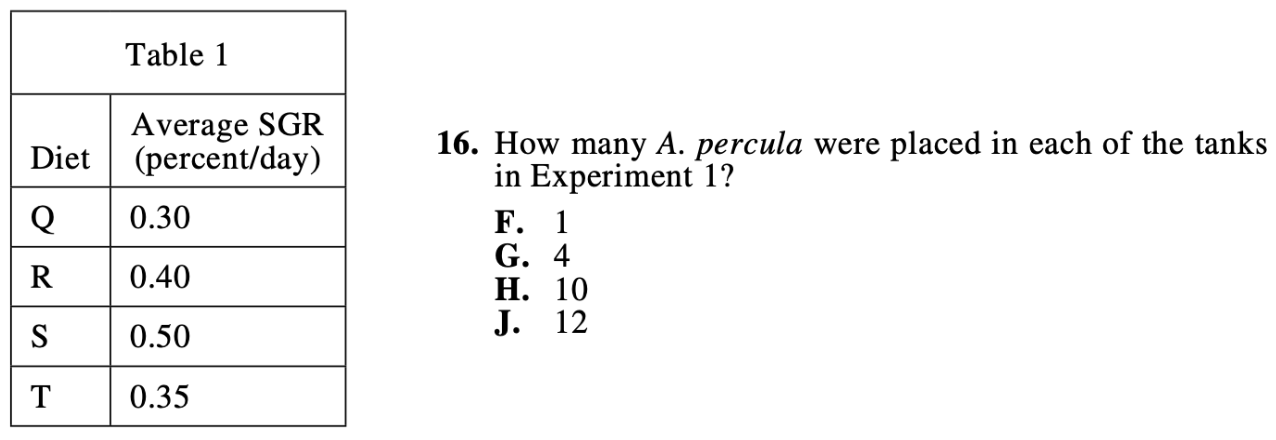
Here’s an example of the data table for a particular experiment and a question that asks about that same experiment:
Source: ACT.org
The key thing to notice here is the gap in language between the question and the table. The data doesn’t seem to include anything about tanks, to say nothing of whatever an A. percula is. This disconnect is your cue to look in the passage. Find the portion that talks about the setup for Experiment 1, then skim for the keywords from the problem.
By using the questions in this way, you ensure that when you do have to turn to the passage for information, it will be in an efficient, targeted manner which makes the most of your time.
Tip 4: If A Question Does Test Science Knowledge, Don’t Panic
As I mentioned earlier, the vast majority of problems in this section will test information that is included in the passages; however, you should expect to see 4-5 questions that do require you to have prior knowledge about a general scientific concept.
If you see a question that you suspect requires prior knowledge, don’t freak out. Instead, follow this process:
Step #1
Check the passage: Many prior knowledge questions are hybrids in that they also incorporate some passage-specific information. In particular, any time a question asks about something more specific or memorization-intensive than foundational biology, chemistry, or physics concepts (‘foundational’ meaning something like the pH scale), it may very well be included in the text. Before you start wondering how the heck they expect you to know the atomic number of cesium off the top of your head, check the passage.
Step #2
Think critically and eliminate what you can: Once you’ve confirmed that a given problem does indeed require outside knowledge, and that you don’t know/remember the particular concept, the next step is to use POE (process of elimination). The majority of prior knowledge questions in Science require only a superficial understanding of the topic at hand, and you may be able to reason your way to the answer.
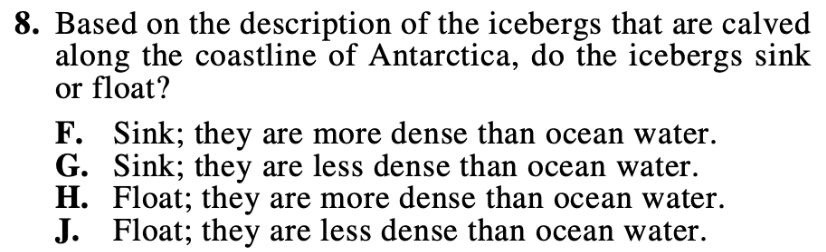
Take the example below:
Source: ACT.org
Density is a core physics concept, but you may not remember how it’s calculated. That’s okay; focus on thinking logically and conceptually.
If you remember generally that density refers to how much material a substance has in a given amount of space, or even just associate higher density with more stuff being crammed tightly in somewhere, you can probably reason that the denser something is, the more stuff it has inside of it, and therefore the less likely it is to float. With that in mind, we can get rid of choices G and H, as something more dense would be likely to sink and something less dense would be likely to float.
Step #3
Guess if you need to: If you’ve checked the passage, done your POE, and still have multiple choices left, it’s time to guess and move on. Remember that you don’t need to answer every question correctly to get a great score on this section; don’t let one problem compromise your pacing for the remainder of the passages. Sometimes, the best you can do is improve your odds, shoot your shot, and keep moving.
The existence of the Science section is one of the most commonly cited reasons that students opt to take the SAT over the ACT; however, that decision is usually based on a few big misconceptions. This section doesn’t require you to have a ton of in-depth science knowledge, it doesn’t require you to read four academic studies’ worth of dry science text, and it isn’t even a required section anymore.
Whether you’re in the process of choosing between the ACT and SAT or prepping to take the Science section for the first time, make sure you recognize it for what it is: an exercise in chart-reading and information retrieval under time pressure, with a few science questions sprinkled in. You can improve substantially on this section by approaching it the right way. And if you’re looking for support in doing that, you know where to find us.