
4 ACT Reading Tips We Wish Every Student Knew
Prior to the ACT changes that occurred in 2025, Reading was probably the section that gave students the most trouble in terms of timing. Since those changes, however, Reading… *checksnotes*... is still the section that gives students the most timing trouble, but it now only occasionally makes them lose the will to live.
That’s obviously an exaggeration, and the “new” version of ACT Reading is a more manageable proposition time-wise, but it still requires you to move quickly: you’ll be asked to read four passages and answer 36 accompanying questions in only 40 minutes. Because you have so little time to waste, it’s essential that you approach this section as efficiently and effectively as possible.
To help with that, we’re going to cover a few of the most important tips and tricks to help you navigate ACT Reading. Let’s dive in.
Tip 1: Be Question-centric, Not Passage-centric
Most students instinctively approach passages in this section by reading the text from start to finish, then answering the questions in the order in which they’re presented. The test even implicitly encourages this approach: if you flip through an ACT Reading section, you’ll notice that the first question in most if not all of the passages is very broad—main idea of the passage, author’s purpose, etc. Their goal is to make you think that you have to read and understand the entirety of the text before you can start the questions, which then increases the likelihood that you’ll run out of time.
Fortunately, this simply isn’t true. Look past the first question or two and you’ll find that the majority of the questions in a given passage ask about specific details; several will even tell you the line numbers or paragraph number where those details can be found. These problems require significantly less initial reading—and therefore less time and effort—to answer than do the broad questions at the beginning.
I recommend that students use a three-step process to navigate an individual passage:
Step #1
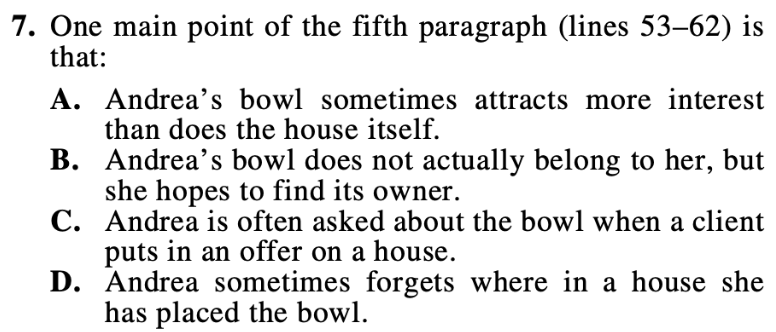
Start each passage by identifying the questions that ask about specific line or paragraph numbers; you’ll use those questions to structure your initial readthrough of the text. If you see three problems that ask about lines 4-7, 20-25, and 51-58, as well as one that references the last paragraph, target those four questions first. Read the excerpts in order, answering each corresponding question as you go.
Source: ACT.org
Step #2
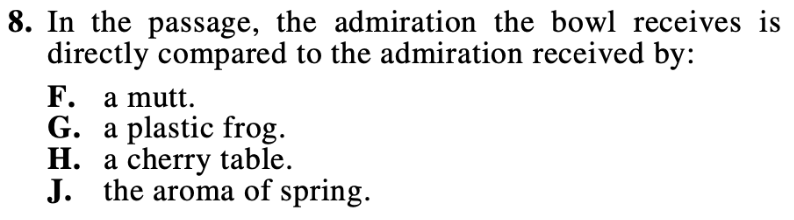
Once you’re finished, you’ll have a general sense of the structure of the passage. Next, look for any questions that ask about specific details but don’t tell you where to find them.
Identify the key words in those problems (or in the answer choices, if the choices use more distinctive language than the question text) and skim for them in the passage to figure out where to read for each problem. You may have encountered some of them in the course of answering that initial wave of four questions, and if you didn’t, you’ll know that they can be found in the other portions of the text.
Source: ACT.org
Step #3
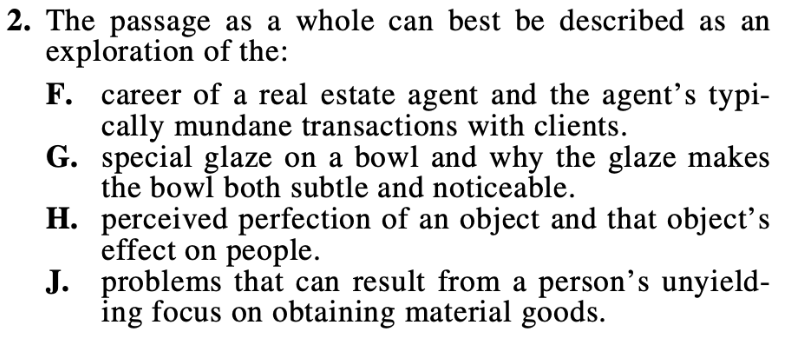
Finally, you should have the 2-3 broadest questions remaining. By this point, you’ve built your understanding of the passage through the process of answering the other questions, which should make the broad questions feel substantially easier. Knock them out, then head to the next passage.
Source: ACT.org
Step #3
Rinse, repeat, and profit.
Tip 2: Be Literal. Like, Really Literal.
Most high school students have taken several years of English by the time they sit for the ACT, which means they’ve spent several years learning to analyze and dissect a piece of text until they can write 2000 words on how the fraying fabric at one end of Jay Gatsby’s ascot is actually an implicit Marxist critique of the treatment of workers in the textile industry. While this skill will undoubtedly be invaluable to them in the real world, it is unfortunately of very little use on the ACT.
This is because one of the only ways to create objective reading comprehension questions is to remove as much of that type of interpretation as possible. In order to craft questions that have only one correct answer, the ACT has to stick to what the text says directly rather than asking about allegories or underlying themes.
Understanding that fact is crucial to navigating the ACT Reading section. If you’re debating between two answers, your primary tiebreaker should be how literally and directly connected to the passage each choice is. Which one requires you to do the least amount of work to justify it? For which choice can you point to something in the passage to support every part of it?
If you catch yourself making assumptions or saying words like “maybe” or “probably” as you’re rationalizing an answer choice, there’s a good chance you’ve strayed too far from the source material. Pump the brakes, refocus on the text, and try again. Remember that on this test, an ascot is almost always just an ascot.
Tip 3: Read Enough
As we discussed earlier, there will typically be several narrow questions on each ACT Reading passage that tell you exactly where to find the relevant information. If you don’t have to go hunting through the text to locate those details, and if we established in Tip 2 that you don’t need to do much if any deep analysis of the text, aren’t these questions just free points?
Not quite. Generally, the way the ACT will add some spice to the narrowest questions in the section is by being a skosh misleading with the excerpt to which they direct you for a given problem.
For example, if a question asks you to select the choice that best captures the definition of the word ‘aioli’ in line 26, you will indeed find the word ‘aioli’ in line 26 of the passage. Typically, though, that line won’t give you enough information to identify exactly what the author means by the word (in this case, the author means that it’s lunchtime). In order to answer the question confidently, you’ll need to read enough of the surrounding passage to understand how the word fits into the 2-3 sentences around it.
And when you are reading, it’s imperative that you do so carefully. This applies to the passages themselves, of course, but also to the answer choices. One of the ACT’s favorite tricks in the Reading section is to give you a long answer choice where the first 90% of it lines up perfectly with the passage and the question; it’s not until the very end of the choice that there’s a word or phrase which invalidates the whole thing. If you’re not paying attention, or if you tune out halfway through because you’re thinking that you’ve found the right answer, you’ll fall into this trap every time.
Tip 4: Don’t Sweat the Comparison Passage
One of the four passages in each ACT Reading section will be composed of two shorter passages, with some questions asking only about Passage A, some asking only about Passage B, and the remainder asking about the relationship between them. This part of the section can be intimidating for students, who sometimes feel like they’re being asked to do twice the work for the same number of possible points.
Don’t stress. First of all, the two mini-passages will typically share a theme—you’re not going to be required to read and comprehend two totally unconnected pieces of text. Second, it’s very easy to adapt your usual strategy in order to make this passage less imposing:
Step #1
Start by approaching Passage A as if it were a standard passage in this section. Go through the A-only questions in order from narrow to broad, exactly like you would normally.
Step #2
Next, move to the questions that ask about both passages. Make an initial pass through each problem and eliminate anything that doesn’t line up with what you read in Passage A. You may not be able to do this for every question (for example, if one asks you how the author of Passage B would respond to something in Passage A), but you should be able to do at least some process of elimination on most of them.
Step #3
Move on to Passage B and complete it as if it were a normal passage in the section.
Step #4
Finish by finalizing your answers for the both-passage questions.
By treating the comparison passage as if it were actually two separate shorter-than-average passages, you’ll minimize the amount of time you spend thinking about both texts simultaneously, which in turn reduces the chances that you get them confused and have to go back to reread.
ACT Reading requires a combination of speed and focus that represents a steep barrier to entry for many testers. The good news, however, is that both of those things can be improved separately, and each one helps the other.
By approaching the passages in the most efficient way possible, you’ll improve your speed, giving you more time to think on each question and thereby providing more margin for error in terms of focus. On the flip side, as you recognize the patterns inherent in the section, each question will require slightly less focus and therefore take slightly less time.
Be patient, and keep practicing—remember that repetition is key. And if you’re looking for help getting started or clearing the final hurdle on the way to your goal score, you know where to find us.